
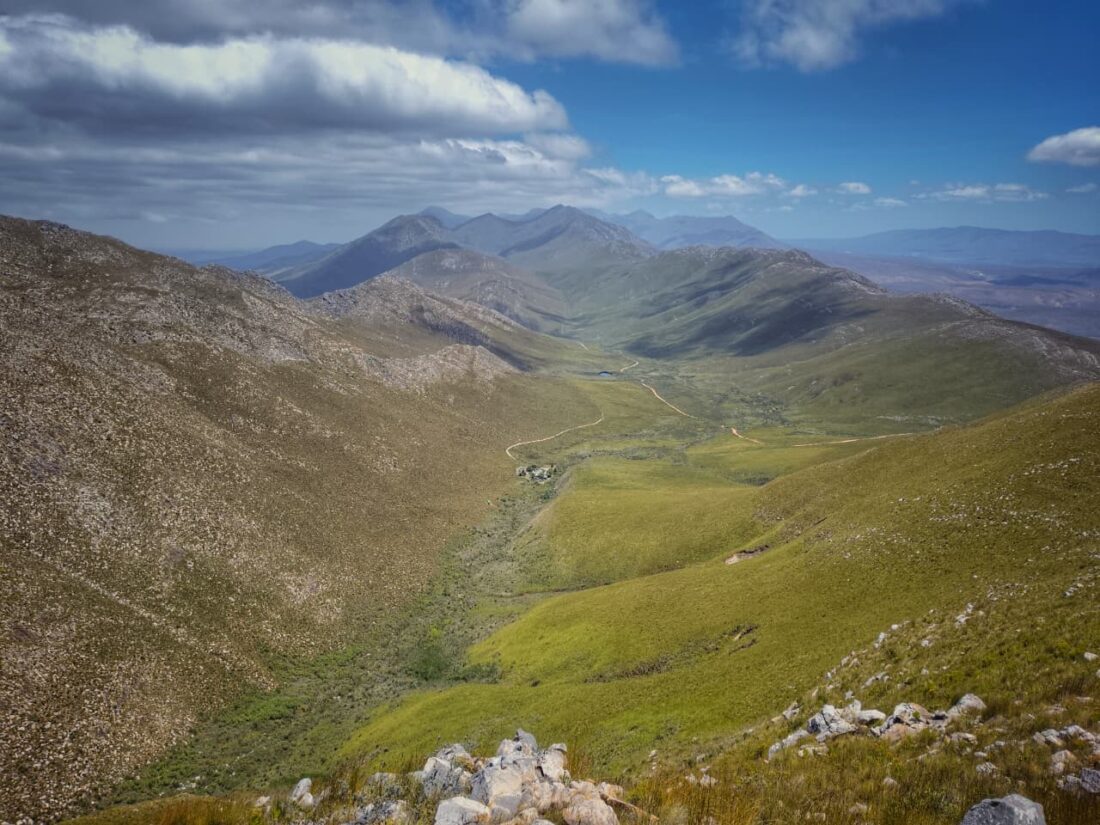
These Mountains Were Chosen to Stay Wild
By Bionerds PTY Ltd
Keir Lynch has a habit of sitting on the edges of things. Cliff edges, mostly, the kind where you swing your legs over and look down into a valley that hasn’t changed much in ten thousand years, and you feel the particular vertigo that has nothing to do with the drop. It’s the feeling of scale. Of realising that the thing you’re trying to protect is so much larger, so much older, and so much more wonderful than any document you will ever file on its behalf.
He was somewhere up in the Langeberg Mountains when the news came through. The Wilderness Nature Reserve had been officially proclaimed. Six hundred and thirty-four hectares of fynbos, named on paper, protected by law, permanent. He didn’t make a speech about it. He probably just looked out across the ridgeline towards the valleys where more of this work still needed doing, and thought: right, then. Next.
There is a corridor in the eastern Langeberg that has been quietly doing what corridors do, connecting things, carrying water, sheltering species that exist nowhere else on Earth, without any official recognition of that fact. On one side lies the Boosmansbos Wilderness Area. On the other, Garcia Nature Reserve. Between them: a chain of a few private farms owned by people who have (well, almost all of them) chosen, against the grain of most economic logic, to leave their land wild. Not out of neglect, and not out of sentiment exactly, but out of something harder to name. A recognition, perhaps, that the land holds more than they do. That it was here before them and, if they make the right choices, will be here long after.
That recognition, held quietly for years by the families who steward this corridor, is where the Fynbos Forever, Forever Wild story actually begins. The Table Mountain Fund believed in what was possible here, and their support is what put Keir and Alouise Lynch on the ground, the team that would support these private landowners to translate their stewardship commitment into legal permanence, one slope and one submission at a time.
“The land holds more than they do. That it was here before them and, if they make the right choices, will be here long after.”
The work of turning a landowner’s conviction into a proclaimed nature reserve is not glamorous. It is meetings and memoranda and carefully worded submissions to provincial authorities, and behind all of that, it is the daily, physical labour of people who do not wait to be asked. On Wilderness Nature Reserve, the landowners – Michael and Justine – organise helicopter-assisted alien clearing across the broader landscape, climb ridges to work on terrain where machines cannot follow, and open their doors to anyone willing to learn what this place holds. On Honeybush Nature Reserve, the same war is waged at a quieter register, rarely a day passes when Kathleen is on-site that she is not tracking down another invasive species in an obscure drainage line or a sun-baked fynbos margin, and doing something about it. The reserves stay wild because the people who own them refuse to let them become anything else.
Into this landscape, already shaped by years of committed stewardship long before any formal project existed, the Table Mountain Fund brought the resources to go further. Keir spends his days climbing, scaling, photographing, finding. He moves through terrain that would persuade most people that a desk job has real merit, all the while building the detailed picture of what lives here and what it needs. The mountains reward the attention. They always give something back to anyone willing to put in the hours to look properly. Alouise gathers everything that comes in, from the field, from the landowners, from the constellation of specialists that a well-cared-for place naturally draws towards itself, and finds the thread that connects it all to the people and the funders who need to understand why it matters.
In late 2025, the first formal milestone arrived through the Western Cape Provincial Gazette. Portions 7 and 15 of Farm 83 were proclaimed as the Wilderness Nature Reserve, land that had been loved and protected by its owners for years now carrying the full weight of South African protected areas legislation behind it. The word proclamation is not a glamorous one, but in conservation law it is as close as language gets to the word forever. That land cannot now be subdivided or quietly converted to something else. It is in the network, and it stays. Three more properties, together covering a further 735 hectares, including Honeybush Nature Reserve, have since been taken through the full legal process, agreements signed and submitted, with CapeNature processing the formal advertising steps. The corridor is nearly whole – just a few more properties needs to be consolidated into the corridor…
“The mountains reward the attention. They always give something back to anyone willing to put in the hours to look properly.”
What the field season gave back, as it turned out, was remarkable. As Keir moved through the landscape and specialists – botanists, ecologists, taxonomists – were drawn in to help build the biodiversity inventory for the newly proclaimed and pending reserves, a picture began to emerge of a place that science had not yet fully met.
A new population of Leucadendron radiatum, listed as Endangered, was recorded – a significant find for a plant whose known range is already precarious. On Honeybush Nature Reserve, plants from the genus Brunia were observed on the steep south-facing slopes. The verdict, which arrived in April 2026, was that they likely represent a species new to science. New to science. Growing on a farm being declared a nature reserve at the precise moment the discovery was made. Flowering specimens were collected in late April and delivered to the university for formal description – the science and the conservation arriving at the finish line together, as if they had planned it.
Elsewhere on the reserve interesting Erica’s, Phylica’s and Psoralea’s were also recorded – and they will probably undergo the same treatment as the Brunia to determine if they too are new to our known world.
“New to science. Growing on a farm being declared a nature reserve at the precise moment the discovery was made.”
The summer of 2025/2026 burned. Wildfires moved through Wilderness Nature Reserve and neighbouring properties, not catastrophe in fynbos terms, where fire is part of the deep grammar of the ecosystem, but a signal that management must respond. Drones mapped the burn scar in detail in March 2026, producing imagery precise enough to direct clearing teams to the places where disturbance had given invasive species an opening. On Honeybush, invasive pine clearing had already been completed the previous winter. The seed bank left behind will keep germinating for years. The follow-up work is less visible than the initial clearance and entirely necessary, the unglamorous discipline of not letting things slip backwards.
Late April brought one more layer. Surveys around the town of Suurbrak, conducted as part of a growing effort to document the cultural heritage of the Langeberg landscape, turned up four previously unrecorded San rock painting sites. The same mountains that hold the new Brunia, the Endangered Leucadendron, the proclaimed nature reserve – they also hold painted walls left by people who knew this landscape more intimately than anyone since. The corridor carries all of it. It always has.
What comes next: three more declarations to finalise, three management plans to complete, acoustic monitoring in the high wetlands listening for frogs in systems that border Garcia Nature Reserve, and surveys across terrain that continues to give back to anyone patient enough to look. The Table Mountain Fund’s support carries the work forward through another season of long climbs and longer paperwork, of specialists drawn towards a place that rewards careful attention, of landowners who wage their quiet, daily wars against anything that threatens what they have chosen to protect.
And somewhere in the Langeberg, Keir is sitting on the edge of something, looking at what is still to be done, thinking: right, then. Next.

Keir Lynch surveying the Upper reaches of the Langeberg as part of the Fynbos Forever, Forever Wild Project, supported by TMF.
*The Fynbos Forever, Forever Wild project is implemented by Bionerds PTY Ltd and funded by the Table Mountain Fund, with co-funding and in-kind contributions from Wilderness Legacy, and Rim of Africa. Project partners include CapeNature, the Gouritz Cluster Biosphere Reserve, and the Grootvadersbosch Conservancy.*

No Comments